

sentimental value
on family and connection and those things we pass down against our will

I can not, for the life of me, recall the last time I stepped foot in a church. But for several years, the closest I came to a place of congregation was the pub. My favourite was a venue in Newtown that practically groaned with the arrival of each patron. The carpeted floor appeared like a Jackson Pollock, a canvas of mottled stains that left your soles sticky and your head light from the concentration of alcohol. It was like stepping into a renovation that had been abandoned months out from completion. You need only scan the walls to see where the money dried up: industrial lighting hung from loose fixtures in the ceiling while the walls were a shoddy mix of tiling and base paint, both of which had a tendency to peel off at any moment.
This was a venue unconcerned with pretences. It defied convention, holding a middle finger up to those establishments that came to be ruled by aesthetic choices that served an Instagram carousel alone. Like arriving barefaced to a first date, it put the onus on the patron. It confronted you with such self-assurance you found yourself searching for the beauty within. To come up short was to leave with the uneasy suspicion that the failure said more about you than it did about the bar itself. Perhaps it was for this reason that the crowd inside felt so comfortable. Tables would swell as strangers folded themselves into any spare seat while the ceiling rattled from the soundcheck taking place upstairs. Eventually, I found myself up there too, stage left, carried along by a guitar lick. When the gig finally ended, the back door swung upon and the smell of stale beer and cigarettes drifted upwards, mingling with sweat and warm bodies in a concoction so pungent it sent us all careening downstairs while the band packed up in peace.
This was a venue I loved, a venue I worshipped with something close to reverence. But on the day I stopped drinking, I never stepped foot inside it again. The city reorganised itself like a jigsaw puzzle, certain areas slotted into my life with ease while others were pushed to the periphery, never to be selected again. Those barstools and booths upon which I had deposited so much of my life were now off-limits, a declaration I enforced alone. There was no reason to give them up and yet I found I could not enter lest I be horrified by the memories conjured underfoot. So, I took to places I knew alcohol wouldn’t make a guest appearance: libraries, book stores, cinemas.
Eventually, the years of sobriety stacked up. My empty hands no longer twitched in search of the comfortable weight of a bottle. My gaze remained steady, no longer scanning the shelves for a spirit that would cause my tastebuds to pucker in revolt. Those places sworn off were no longer off-limits as simply unalluring. But my love for the cinema remained. The crowd was always different depending on the timing and genre, but I found a sense of congregation all the same.
Late last year – or was it early this year? – somewhere in that long stretch of Nothing Time between Christmas and the New Year, I took myself to church to watch Sentimental Value. The heat was relentless, settling in before midday with no cloud cover to offer respite. In my air-con-less room, the walls were perspiring and the bedsheets clung to my skin like cling film. Restless and too sweaty to think, I went to the only establishment that promised an arctic blast no matter the forecast.
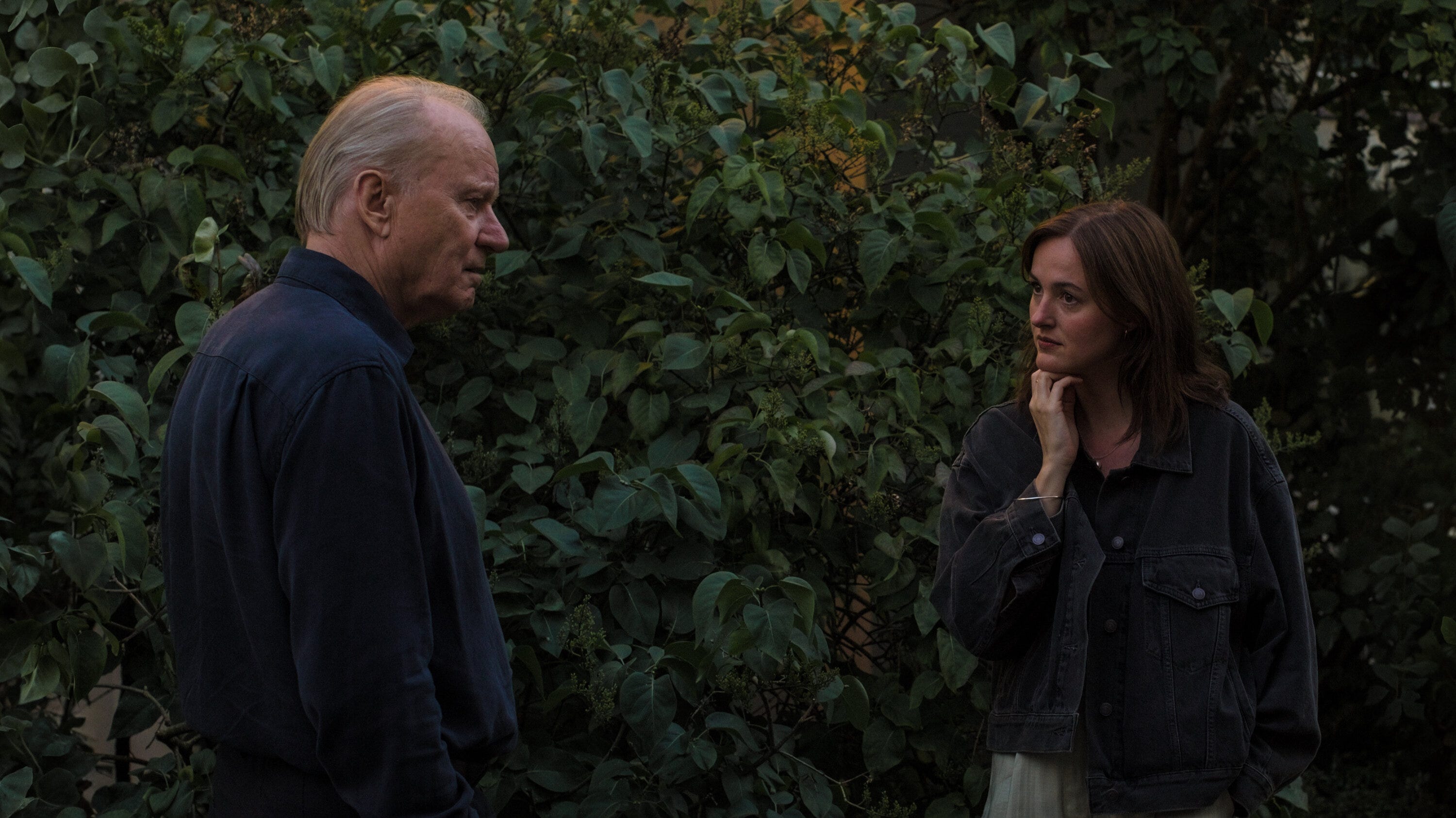
To put it mildly, the film is exactly my flavour rice cracker. It tells the story of a family in which misunderstandings between members have festered, causing relationships to splinter and fracture. At its heart are two sisters, Nora and Agnes, who are forced to confront their father Gustav after the death of their mother. The father in question is a once-famous filmmaker who has been estranged for some time and now seeks retribution with a script he thinks is really something. Nora is an actress, Agnes a researcher and while even their dynamic is complex, it pales in comparison to the relationship they each share with their father.
The film opens on the family home which serves as a vessel of memories. As a tracking shot takes us inside, each door that opens brings us deeper into the psyche of this family and the trauma they have since struggled to untangle, interrogate, and understand. Tension beats rhythmically throughout each scene and yet it never ruptures even when you’re begging it to, if only for the respite that will surely greet you on the other side. But we don’t get a sense of catharsis or climax. We also don’t get a single character that isn’t in crisis. They are all flawed, hurt, and searching, but the conflict is subtle. It doesn’t take the form of blows or words hurled like artillery fire. Instead, it exists in the silences and in all the things left unsaid, whether for fear of repercussion or, more often, for fear of what those words might force the speaker to confront.
Having seen The Worst Person In The World, I knew something coming from director Joachim Trier would surely knock me out emotionally. Still, I was surprised by the force of it. I emerged from the cinema shell-shocked, hollowed out and empty in a way I’ve only known to follow a sit-down shower cry. But to understand the weight of my emotions, you first have to understand Gustav. You have to understand that this is a man who can’t express his love; that though his daughters sense its presence like a shadow in the room, they can’t touch it. You have to understand that he and Nora are so alike they seem incapable of connecting, repelling each other like opposing magnets. You have to understand that this is what the film asks: what do we pass down to our children? What do we inherit from our parents with no say in the matter? And more pressingly: how do we reconcile those two feelings, grieving a love that was always there, but one that never arrived in the form we needed it to?
Somewhere between belting the chorus of Michelle Branch’s All You Wanted with windows down to being hit with four demerit points after a siren flared from a cop car parked in the shrubbery of that unsuspecting highway, Marcus and I got to talking about creative paths and the sacrifices that come with staying the course. I am prone to eye rolls when it comes to any discussion about protecting one’s craft but amidst the current climate of AI slop, it’s hard to deny that creativity is under siege.
The thing is, it’s no easy feat to surrender yourself to a creative calling or pursuit. Sure, there are the films that glamourised journalism and had you believing dreams of long-form would inevitably end with being chased over Manhattan bridge by Matthew McConaughey, but if that was once a reality it has long faded from view. Creativity is not a question of work ethic. If it were, I would surely have something to show for myself and these past years spent flailing, casting aside all rational belief despite a dying industry and slaughtered budgets in the hopes that I might make it. You still have to show up, that much is pivotal. But even then, you can hunch over the desk for hours on end as days bleed into weeks that bleed into months that prove fruitless. When you finally come up for air, the view is devastating: yours is a barren crop with nothing to harvest.
It’s probably for this reason that artists are all that little bit too strung out and fried. We’re searching for it constantly; trying to generate a creative output one can trust implicitly, knowing we need only rise in the morning to plant the seed and find it ready for harvest come nightfall. At the first flicker of fruit, we convince ourselves we’ve stumbled upon the secret. We begin rearranging our lives around whatever conditions happened to exist when inspiration last arrived. We wake earlier, drink less. We read different books, sit at the same cafe, and take the same route home. We become farmers studying the sky for signs, searching for patterns where there may be none, hoping if we recreate the conditions exactly, the harvest will return.
But creativity doesn’t care for bargains. It can’t be coaxed into existence through discipline alone, nor summoned through sheer force of will. We can till the soil, plant the seed and show up every day with dirt beneath our fingernails, but whether anything grows remains stubbornly beyond our control. I heard Jon Bellion put it best in a recent interview: we are not the source of the thing, we are merely the instrument. We can keep ourselves tuned and available, but we never know if inspiration will choose to play through us when we sit down each morning. It’s this that keeps it interesting if not a source of grave despair.
Where most pursuits offer some assurance that effort will eventually be rewarded, I have not found this to be true in writing. And as I’ve gotten older, it’s become increasingly hard to suspend all rational belief. Everyone is an artist until the rent is due, they say. Well, the rent is due and I can’t make ends meet. Financial stress consumes every thought and comparison licks at my heels, sending my gaze to those peers who have either struck gold creatively or chosen careers that have a clearly demarcated trajectory where hard work leads to a promotion and so on after another.
It’s this Marcus and I were deliberating. This is the path we want to stay on more than anything else. And despite the at times crippling self-doubt and flashes of imposter syndrome, somewhere inside of us exists the belief that we might just make it. That this thing we love so much will in turn come to reward us, if not monetarily then in the sense that we will find fulfillment in the process. But we also know that as we stay the course, we cut ourselves off from other routes; routes that would remove friction, abolish financial strain, and offer up a life that doesn’t demand we take to each day with scrappiness but instead can enjoy comfortably.
I think often of a Malcolm Gladwell story that saw the writer compare late bloomers to the marvel of the child prodigy. Gladwell uses the author Ben Fountain as an entry into his argument, establishing the fact that Fountain completed law school only to realise his aspirations lay in fiction. Discovering that the mental demands of law were too taxing to allow him the clarity to write after work, Fountain quit his job to devote his time to writing. Again, the concept of work ethic and discipline comes into play as Fountain establishes a routine: he sits down at the kitchen table at 7:30am and writes until lunchtime, taking a twenty minute break to rest his mind before clocking up more hours as the day drags on. Fountain does, by all accounts, succeed at his dream of publishing a novel. In fact, in his first year he sold two stories. Then, he published Brief Encounters with Che Guevara, which won the Hemingway Foundation/PEN award and was named a number one Book Sense Pick. The accolades for such a novel were sweeping. But as the media ran with the narrative that Fountain was an overnight sensation, Gladwell reveals the truth: he quit his job in 1988 and for every story published in those early years, he had at least thirty rejections. As for the novel, it was published in 2006 – eighteen years after he made the decision to first sit down to write at the kitchen table. Fountain was 48 when he achieved literary success.
Gladwell writes: “On the road to great achievement, the late bloomer will resemble a failure: while the late bloomer is revising and despairing and changing course and slashing canvases to ribbons after months or years, what he or she produces will look like the kind of thing produced by the artist who will never bloom at all. Prodigies are easy. They advertise their genius from the get-go. Late bloomers are hard. They require forbearance and blind faith.”
Blind faith. That is the thing anyone who does this craft must possess. But there are other things, too. Things that apply to Fountain and draw a throughline to other creative talents that have been afforded the opportunity to bloom later in life. Namely, he had a patron in the form of his wife, Sharie. “If you are the type of creative mind that starts without a plan, and has to experiment and learn by doing, you need someone to see you through the long and difficult time it takes for your art to reach its true level,” says Gladwell.
Here is the part that gets me: “Late bloomers’ stories are invariably love stories, and this may be why we have such difficulty with them. We’d like to think that mundane matters like loyalty, steadfastness, and the willingness to keep writing checks to support what looks like failure have nothing to do with something as rarefied as genius. But sometimes genius is anything but rarefied; sometimes it’s just the thing that emerges after twenty years of working at your kitchen table.
‘Sharie never once brought up money, not once – never,’ Fountain said. She was sitting next to him, and he looked at her in a way that made it plain that he understood how much of the credit for Brief Encounters belonged to his wife. His eyes welled up with tears. ‘I never felt any pressure from her,’ he said. ‘Not even covert, not even implied.’”
On Monday, I found myself sitting opposite a therapist for the first time. The office was spacious and, with its pastel hues, indoor foliage and empty fireplace lined with paperbacks, exuded a calm I’ve only ever known while submerged in a deep tub in the middle of winter, the high concentration of Epsom salts causing my vagina to tingle as Enya played in the background.
I was thankful for the office decor. It was evening then and the days leading up to it had been spent with palms clammy, mind racing. I didn’t know what one did in therapy let alone what to expect. I kept running over TV depictions in my mind. I was hyper-fixating on the details. Did I walk in and lie down on the couch? Was it presumptuous to assume there’d even be a couch? If there wasn’t a couch, would there be a chair? Or was it best to simply flop down on the carpet? These were the things that occupied my thoughts. Not, what should I talk about or what concerns were most pressing to discuss? Really, I just wanted a floorplan with accurate furniture renderings made available to me prior to my appointment. None were received and so, when my therapist opened the door and I saw a long couch against the wall with a table before it surrounded by two chairs, I looked down at them half-crazed.
“Fuck. Chairs and a couch,” I said. “Where do you want me?”
I took the couch.
I began talking, painting in broad brush strokes the context surrounding my visit. I had noticed the box of tissues positioned within arm’s reach and recall finding it vaguely insulting. But as I came to describe the reason for my visit at the ripe old age of 32, I reached for them. Mum would not allow us to say it. We had to remain positive, think good thoughts, never speak something into existence that could be overcome. But in this room, I told him that my father is dying. He was first diagnosed with cancer in 2016 and while he’s undergone three rounds of chemotherapy and a stem cell transplant to varying success, the cancer has since returned only to meet a body significantly older with far less energy to sustain the fight. He went into hospital late February and has only had a handful of days at home since, each one leading into another complication, another infection, another visit to the emergency ward and weeks spent undergoing tests.
I suppose that is why I was there. My dad is very ill and I am sad about it. My dad is very ill and it has caused immense stress on the rest of the family, namely my mum who is navigating what it means to find yourself alone in old age. My dad is very sick and I do not want to be that child that falls apart and finds themselves swallowed up in grief. But really the truth is this: my dad is very ill and I am angry. Such an ugly word, an ugly feeling, but one I can’t escape. Beneath the layers of sadness and despair, it’s there, pulsing with energy like blood behind a bruise.
Alone, if I tried to follow that path of anger, if only to interrogate it and send it on its way, I would be redirected swiftly. It was as if my own psyche was short-circuiting and couldn’t bear the acknowledgement of such a feeling. One moment I was irate, the next flooded with guilt, then grief, before circling back to anger once more. In therapy though, I tried to stay the course.
Is it age or simply the urgency illness imposes? Whatever the case, I see more easily today the path my dad chose and the consequences that have befallen those decisions. Just as Marcus and I discussed in the car, to choose a particular route is to shut yourself off from another and in the case of my dad, those selected draw a straight line from his own selfish ambitions to the chaos they brought to our family. Opportunities were chased, business ventures conjured, and plans were devised. But nothing ever came together. His was a mindset that success sat just over the next hill if only he could reach it and he followed that with dogged determination. He showed up to the kitchen table day in and day out, possessing a work ethic that was unmatched. But as I have come to know, success isn’t predicated on discipline alone. He tried but the crop remained barren with nothing to harvest.
Perhaps he was a late bloomer and all his efforts were still too early in development to resemble anything other than a failure. But the difference between Fountain and my dad is that those around him never wanted to be a patron but were instead forced into the role. There was love there, sure, but such a story sours when it comes at the expense of your own dreams. I never paid much attention to it until I got older and the blind faith I had in him sharpened into focus. With greater clarity came a revisionist history of sorts and I could only see the sacrifices made by all those in his orbit. My mum, my brothers, even myself.
It’s hard to say whether this is the root of my anger or if I, too, am so selfish as to find its root in something far more personal. Like the fact my biggest fear is that it’s this I have inherited from him and now, I am seeing patterns repeating. Too many harvests have come in which I have nothing to show and yet I have stayed the course only to wonder if it might be too late for me now. Is it too late to start again? To hope for a fresh start? To try my hand at something else? I can’t bear the thought of dragging someone into this mess. And so I keep love at arm’s length, having seen what it does to someone when theirs is a role that demands more and more from them until they are responsible for holding the whole thing together.
There has been no plot point here, no through line, and I apologise for it. This piece has to arrive somewhere for your reading to be worth anything, after all. But for the life of me, I can’t work it out. There is no clean narrative, just various contradictions. I can be angry at my dad and still recognise that there is deep love there; that, more than anything, I wish it had all worked out and he had found a place to direct his potential, or an industry that would at least reward it. Maybe things will turn around. Maybe it will happen. That is all I can think to say. None of us get to know whether the harvest is just one season away.
Beautiful Jess. Thank you for sharing with the world. Perhaps the therapeutic experience will be a helpful collaborator for footnotes.
I was moved after moved after moved reading this. Thank you for what you constellated here. It helped me tonight! Sending you and the family love, the same you give yourself in expressing truth like this, "And so I keep love at arm’s length, having seen what it does to someone when theirs is a role that demands more and more from them until they are responsible for holding the whole thing together."